
Never Attach to Brick Veneer
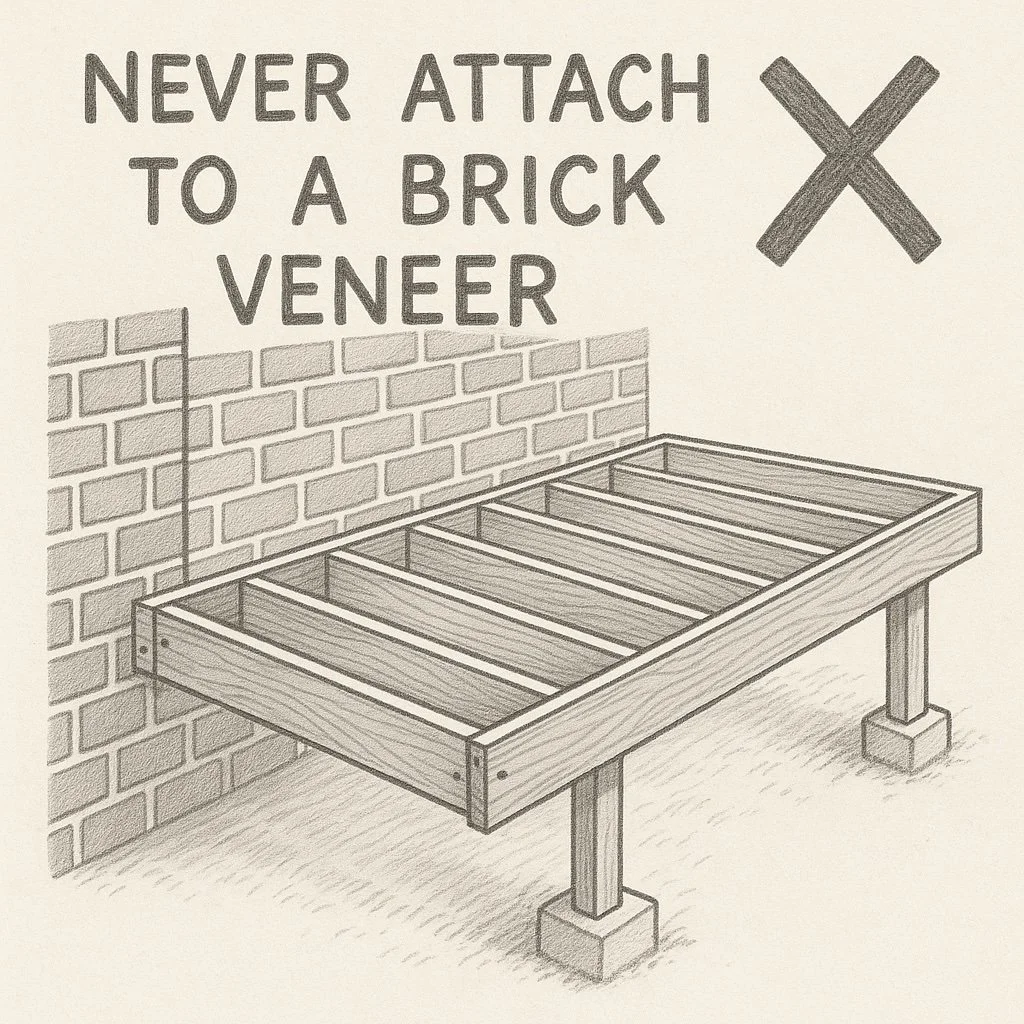
Why You Can’t Attach a Deck to Brick Veneer: Common Code Violation & Safe Solutions
Many homeowners—and even some contractors—don’t realize that attaching a deck frame directly to brick veneer is not only unsafe but explicitly prohibited by residential building codes. While brick may appear strong and stable, it’s not designed to support structural loads like a deck. This oversight is one of the most common code violations in deck construction today—and one of the most dangerous.
Let’s explore why it’s not allowed, what the code says, and how to build safely and legally around brick veneer.
What is Brick Veneer Construction?
Brick veneer is a non-structural layer of brick attached to the exterior of a wood- or steel-framed wall. It serves aesthetic and weatherproofing purposes but does not support the weight of the building.
Characteristics of Brick Veneer:
Usually 1-wythe thick (about 3–4 inches)
Anchored to structural framing with metal ties
A gap (air space) exists between brick and structural wall
Not load-bearing
That last point is crucial. Brick veneer is simply a façade, not meant to carry the weight of a deck or any other heavy load-bearing structure.
Code Reference Prohibiting Ledger Attachment to Brick Veneer
The 2021 International Residential Code (IRC) makes this prohibition clear:
IRC Section R507.9.1.1(1):
“Deck ledgers shall not be supported on stone or masonry veneer.”
This rule exists to prevent catastrophic deck failures and protect homeowners from legal and physical harm. Nearly every Pennsylvania municipality enforces this rule, often during the permit or inspection phase.
Why Attaching a Deck to Brick Veneer is Unsafe
1. Brick Veneer is Not Structural
It’s not anchored to the foundation in a way that can support vertical or lateral deck loads.
The load path is broken; forces from the deck are not transferred safely to the home's framing.
2. Fastener Failure and Brick Cracking
Bolts and lag screws can pull out of the veneer or crack the brick.
Over time, vibration and thermal expansion make fasteners loosen, leading to deck collapse.
3. Moisture and Rot Risks
Trapped moisture between the deck ledger and veneer can cause rot in the framing and brick spalling.
Water infiltration can lead to mold, structural decay, and expensive repairs.
4. Collapse Cases and Legal Liability
There are numerous documented cases where decks have collapsed due to this exact mistake.
If someone is injured, the homeowner may be legally responsible for not following code.
Common Misconceptions Homeowners Have
“It looks strong enough.”
➤ False. Brick may look tough, but it isn’t meant for tension or point loads.“My contractor said it was fine.”
➤ Bad advice. Always confirm with local building officials.“It’s cheaper this way.”
➤ Perhaps short-term, but long-term risk and liability are not worth it.
Approved Alternatives to Ledger Attachment on Brick Veneer
1. Free-Standing Deck Framing
The safest and most widely accepted method.
Use posts and footings close to the house to support the deck independently.
No ledger board is needed.
Can still appear "attached" visually with close spacing and trim.
Meets all code requirements
Reduces water intrusion risk
No penetration of brick veneer
2. Ledger-to-House Framing Through Brick (Engineered Method Only)
Some engineers approve this under very strict conditions:
Remove a section of brick to expose the house’s structural framing.
Attach the ledger directly to rim joists with proper flashing.
Reinstall brick around, with a moisture gap.
Requires engineering, permits, and inspections
Not a DIY project
3. Bracket and Spacer Systems (Rarely Approved)
Some third-party mounting systems claim to allow ledger attachment over veneer using brackets and compression blocks.
Code acceptance varies by municipality.
Must provide engineer-stamped plans and product specs.
Not a guaranteed approval
Often costs more than freestanding framing
How Inspectors Identify This Violation
Local code inspectors will flag decks that:
Show lag bolts/screws penetrating brick
Lack visible posts near brick walls
Don’t show permit records for deck framing
🛠️ Correction often means removing the ledger and retrofitting footings.
Cost Comparison: Attached Deck vs. Free-Standing
Deck Type Material Cost Labor Cost Permit Difficulty Ledger on Brick (illegal) Low Low Fails inspection Free-Standing Deck Moderate Moderate Passes inspection Engineered Ledger (through veneer) High High Complex approval
Best Practices for Safe Deck Design Near Brick Veneer
Use spanning beams and close-set footings to create stability without the house wall.
Use flashing and drip caps if installing near brick to prevent moisture wicking.
Include diagonal bracing for added stiffness.
Frequently Asked Questions
1. Can I attach a deck ledger to brick veneer if I use long bolts?
No. Brick isn’t designed for shear or pull loads. It will crack or fail.
2. What if my old deck is already attached to the brick?
You should have it inspected immediately. Many older decks were built before code enforcement increased.
3. Will a free-standing deck feel less stable?
Not if built correctly. Proper posts, footings, and bracing ensure excellent performance.
4. Is attaching through the brick into the house framing allowed?
Only if done per an engineer’s instructions and after removing the brick.
5. Do I need a permit to replace a deck ledger on brick?
Yes. Structural repairs always require permits in PA.
6. Can I use metal spacers or brackets over the veneer?
Maybe—but only if it’s an approved, engineered system and cleared with local inspectors.
Conclusion
Attaching a deck to brick veneer is a serious code violation with dangerous implications. While it may seem strong enough, brick is not structural and cannot safely support a ledger. The good news? You have safe, legal options—like freestanding framing or engineered connections through exposed framing. When in doubt, always consult your local building official or a licensed contractor to keep your project code-compliant and catastrophe-free.
Shall we talk about your wonderful new deck?
