
Can I Grandfather It In?
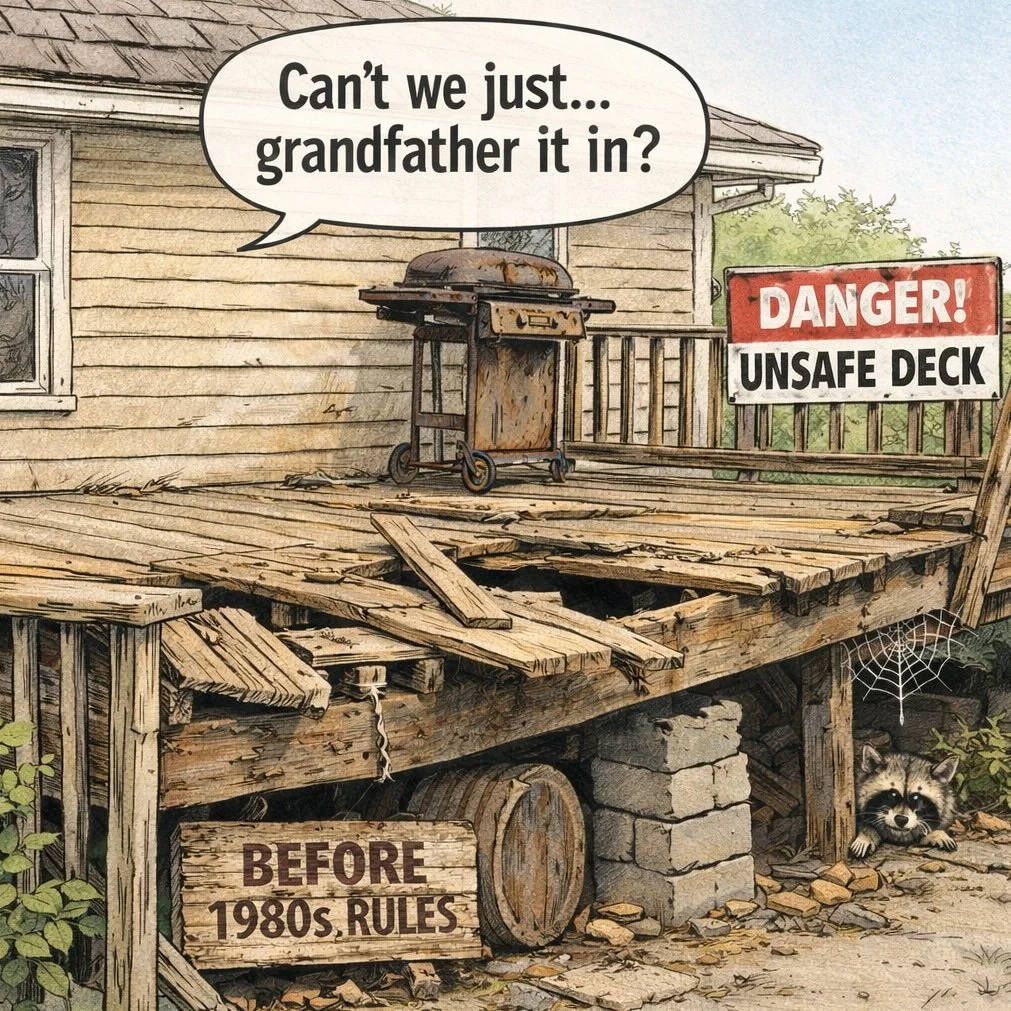
“Can I Grandfather It In?” Why Unsafe Decks and Structures Still Have to Meet Today’s Safety Standards
One of the most common questions homeowners ask when discussing deck repairs or replacements is:
“Can’t we just grandfather it in?”
It’s an understandable question. Many homes have decks, porches, and exterior structures that were built decades ago—sometimes 30 or 40 years ago—under building codes that looked very different from today’s standards.
But when it comes to safety, there is an important truth that often surprises homeowners:
Unsafe structures cannot be grandfathered in.
If a structure is unsafe, deteriorated, or fails to meet basic safety requirements, it must be repaired, rebuilt, or removed so that it meets modern building standards.
Let’s walk through why.
What “Grandfathered In” Actually Means
In construction and building codes, the term “grandfathered in” usually means that a structure that was legally built under a previous code can remain in place as long as it is safe and unchanged.
For example, an older deck may have been built with railing spacing or framing details that were acceptable at the time it was constructed. If that deck is still structurally sound and not being modified, many municipalities will allow it to remain.
However, this only applies to structures that are safe and structurally sound.
The moment a structure becomes unsafe, deteriorated, or is being significantly modified, the grandfathering concept no longer applies.
Unsafe Conditions Must Be Corrected
Building codes are designed to protect the safety of homeowners and their guests. Because of that, there is a simple rule that applies across most municipalities and code enforcement agencies:
Unsafe structures must be repaired, replaced, or removed.
Examples of unsafe deck conditions include:
Severely rotted framing or posts
Loose or failing ledger boards attached to the house
Missing or unsafe guardrails
Staircases that are unstable or improperly built
Structural members that are undersized or failing
Decks that are pulling away from the home
When conditions like these exist, inspectors and contractors cannot simply “leave them alone” because they were built a long time ago.
They must be brought up to safe standards.
Why Modern Deck Codes Are Stricter
Deck construction standards have changed significantly over the past few decades, largely because of structural failures that have caused serious injuries and fatalities.
Modern codes now require important safety improvements such as:
Proper ledger flashing to prevent water damage
Through-bolted ledger connections instead of nails
Larger beam and joist sizes
Stronger guardrails
Correct footing depth below frost line
Improved stair construction and handrails
These updates are designed to ensure that decks can safely support people, furniture, snow loads, and years of outdoor exposure.
When Codes Must Be Updated
Even if a structure was once compliant, code updates usually become required when:
A deck is repaired or rebuilt
Structural components are replaced
A deck is expanded or modified
A permit is pulled for work
A safety issue is discovered
In these cases, the updated structure must meet current building codes, not the standards from when the deck was originally built.
The Goal Isn’t Paperwork — It’s Safety
At the end of the day, building codes are not about bureaucracy or making projects more complicated.
They exist to ensure that structures people rely on every day are safe, durable, and built to last.
A properly built deck should give homeowners confidence that it can safely support their family and friends for many years to come.
A Better Approach: Build It the Right Way
When homeowners ask about grandfathering in unsafe conditions, the best path forward is usually not patching or working around problems.
Instead, it’s taking the opportunity to:
Correct structural issues
Update framing and connections
Improve safety and durability
Build a deck that will last decades
That way, the structure isn’t just “good enough for now”—it’s something that can truly stand the test of time.
Final Thoughts
While the term “grandfathered in” is often used when discussing older homes, it doesn’t apply to unsafe conditions.
If a structure poses a safety risk, it must be repaired, rebuilt, or removed so that it meets modern building standards.
And while that can sometimes feel frustrating at first, those standards exist for a very good reason:
To protect the people using the space every day.
